Why we talk about blue
and green.
The blue economy and the green economy are not the same conversation. They emerged from different starting points, and from different parts of the world. Understanding why both exist is the first step toward understanding how, together, they describe a single agenda for a sustainable, equitable economy.
2012
At the 2012 UN Conference on Sustainable Development, better known as Rio+20, the international community endorsed the green economy as a framework for sustainable transitions, low-carbon, resource-efficient, and socially inclusive.
But coastal states and Small Island Developing States (SIDS) made an argument that has shaped the conversation ever since. The "green" frame, they noted, was implicitly land-centric. It underrepresented the realities of nations whose economies, livelihoods, food systems, and cultural identities are anchored in oceans, freshwater systems, fisheries, and coastal ecosystems. For these countries, the sea is the economy.
Out of that argument, the blue economy was given its name, an explicit recognition that sustainable development must include the systems on which more than a billion people directly depend.
Two perspectives,
one continuum.
A decade later, the two are not in opposition. They emerged from different starting points but converge on the same questions. How does an economy regenerate the systems it depends on? How does it leave behind more livelihood, more biodiversity, more resilience than it found? How does a transition reach communities on both sides of the coastline?
Land and sea are one continuum. Watersheds carry sediment to coral reefs. Fisheries and farms share supply chains, climate exposure, and labour markets. Coastal cities and inland regions face the same climate risks under different forms. The most consequential decisions sit precisely where blue and green meet, and that is where Thalafaro works.
 Two economies, one agenda
We help you explore
and harness the linkages.
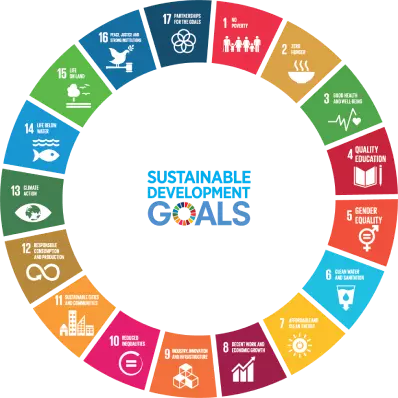
Our work shines light on the spillovers across the Sustainable Development Goals, where decisions in the blue economy compound in the green, and the other way around. Below are six places we see the two agendas reinforce each other in practice, and where engagements often start.
Spillovers across the SDG agenda.
A virtuous
health cycle
Healthy soils, watersheds, forests, and oceans deliver public health and good food in the same breath. Sustainable fisheries and regenerative agri-food systems share supply chains and climate exposure, the ecosystem we restore upstream is the one that feeds us at the coast.
Jobs across the transition,
skills of tomorrow
The shift to a low-carbon, ocean-positive economy is creating new livelihoods across coastal and inland regions. From offshore renewables to regenerative agriculture, it needs marine biologists, solar technicians, and the education systems to train them, the largest poverty-reduction opportunity in a generation.
Energy revolution,
innovation of the future
Offshore wind, tidal, marine bioenergy, terrestrial solar, sustainable biomass, the renewable mix the world needs is necessarily blue and green. Marine biotechnology, agroecology, and climate-smart engineering accelerate in both economies, with the most promising breakthroughs at their intersection.
Source-to-sea
approach to water
Pollution and sediment carried by inland rivers shape the health of every estuary, mangrove, and coral reef downstream. A source-to-sea approach treats watersheds and oceans as one system, what we keep out of the river is what we save at the coast.
Resilience across territorial scales,
from cities to coasts
From sea-level rise to inland heatwaves, resilience must be built across territorial scales. Nature-based solutions like wetlands, urban forests, and blue-green infrastructure protect communities and ecosystems at a fraction of the cost of grey alternatives, from inland watersheds out to the coast.
Governance between
and within boundaries
A transition that excludes the people most affected is a transition that fails. Governance that works between and within boundaries, fair benefit-sharing, gender-inclusive design, multi-stakeholder coordination across fisheries, forests, farms, and ministries, is what makes the change durable.